
The question “How much does a website cost in 2026?” has no single correct figure. A one-page site used to validate demand, a corporate website with dozens of services, an online store connected to inventory, and a web platform with user accounts are different products. They differ not only in page count but also in discovery, design, development, integrations, testing, and post-launch responsibility.
A reliable price therefore begins with scope. The team needs to know who the site is for, what action visitors should complete, who owns content, where products or leads will go, which systems must connect, and how success will be measured. The ranges below are current 1 Web Development starting packages followed by a detailed explanation of what turns an initial estimate into a real project budget.
Indicative budgets for different website types
These figures are not generic market averages. They are the starting formats published on our service pages in 2026. The lower level assumes a defined and typical scope. Custom business logic, large content volumes, urgent delivery, or complex integrations require a separate estimate.
| Project type | Basic | Optimal | Advanced |
|---|---|---|---|
| Landing page | from $600 | from $1,400 | from $2,000 |
| Corporate website | from $1,500 | from $3,000 | from $5,000 |
| Online store | from $2,000 | from $4,500 | from $6,000 |
| Online service | from $5,000 | from $7,000 | from $10,000 |
Basic does not mean poor quality. It describes a compact solution with clear boundaries: a defined number of templates, standard forms, prepared content, and few external systems. Optimal typically adds custom UX/UI, a broader structure, analytics, and practical business integrations. Advanced covers complex roles, automation, several data sources, higher loads, or network-level architecture.
Why websites of the same type have different prices
Two corporate websites may each contain twenty URLs but have very different complexity. One reuses a service template, receives ready content, and sends forms to email. The other includes a solutions catalogue, languages, location pages, careers, CRM, old-site migration, and editorial permissions. The menus look similar, but the work does not.
An online store with one hundred products can also be harder than a catalogue with ten thousand items. Configurable products, personal prices, warehouses, bundles, subscriptions, and custom delivery put the cost into rules rather than product count. A large predictable import may be easier than a small catalogue containing many exceptions.
Website cost reflects the number of decisions, states, data flows, and scenarios the team must implement and verify, not merely the number of screens.
What a development estimate contains
A professional proposal separates the budget into stages and deliverables. This shows what will be produced, where uncertainty remains, and which decisions affect cost. An estimate without boundaries is difficult to compare: one supplier may include discovery, content entry, QA, and launch while another quotes development alone.
Discovery and requirements
The team defines audiences, goals, key actions, constraints, competitors, acquisition channels, and success criteria. A compact site may require a brief and workshop. A platform with several roles needs interviews, process descriptions, a data map, integration inventory, and technical concept.
Removing discovery can appear to save money. In practice, decisions then happen during design or coding, when structural changes affect completed work. Several days of discovery are usually less expensive than rebuilding an account, catalogue, or integration after stakeholders interpreted the task differently.
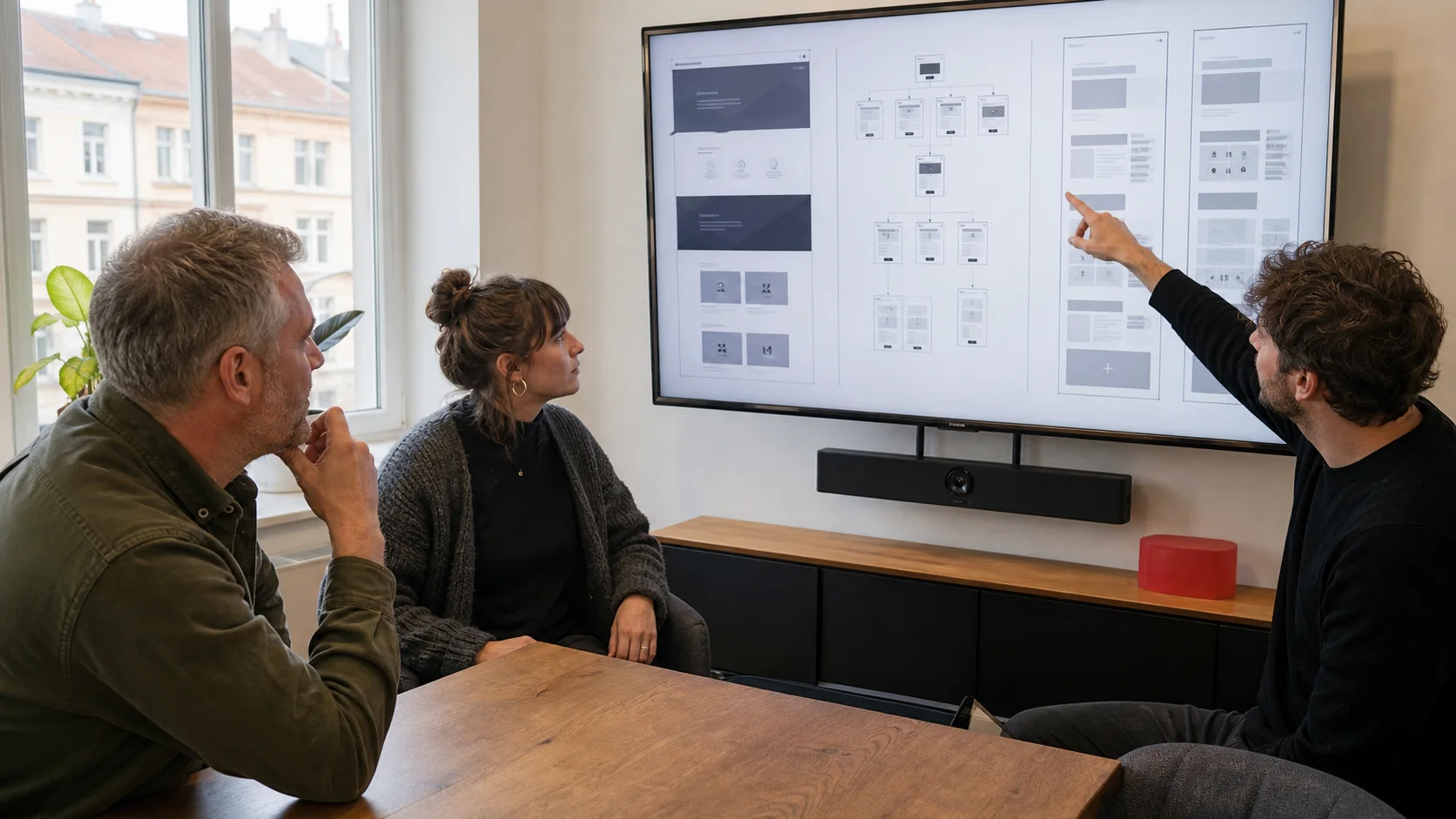
Information architecture and prototype
Architecture defines sections and relationships; a prototype defines page logic before visual styling. It tests priorities, navigation, block order, forms, filters, and mobile journeys. One reusable template costs less than many unique pages even when their combined word count is similar.
For commerce, prototyping includes catalogue, product page, basket, checkout, and account. For a corporate site it covers services, cases, team, locations, and forms. For a service it also includes roles, empty states, errors, and recovery. More custom journeys mean a larger planning budget.
UX/UI design
A template launches faster but asks the business to accept existing assumptions. Custom design includes visual direction, a design system, key page layouts, responsive versions, and component states. Animation, original graphics, unusual transitions, and many one-off blocks increase the estimate.
Design pays for clarity rather than decoration. It should explain the offer, support comparison, build trust, and make action easy. If a design only covers a wide desktop and ignores form errors, navigation states, or mobile checkout, that work has merely been shifted into development.
Frontend and backend
Frontend turns layouts into a responsive, accessible, and performant interface. Backend owns data, CMS, users, permissions, orders, business rules, and integrations. A simple landing page may only require form handling; a web service puts most of its effort into backend behaviour.
Reliability requirements also matter: validation, logs, queues, retries, fallbacks, tests, and monitoring. A happy-path demo is quick. A product that handles declined payments, API failures, duplicate submissions, and lost connections requires substantially more engineering.

Functionality that changes the budget most
Information pages, a blog, and a basic form are predictable. A calculator, configurator, account, booking system, marketplace, subscription, loyalty programme, or document approval workflow creates a product within the site. It needs rules, UI, a data model, administration, and testing.
CMS and editorial roles
“We need an admin panel” is not a specification. The estimate depends on editable entities, permissions, drafts, versions, approvals, scheduled publication, and change history. One editor needs simple fields. A network with central and local teams needs a permission model that prevents one branch from changing another branch’s content.
CRM, ERP, payment, and other integrations
An external system is estimated after reviewing documentation and test access. Fields, data direction, authentication, limits, success status, duplicates, and failure handling must be agreed. A CRM name alone says little: one project only creates a lead, while another synchronises contacts, deals, products, prices, and statuses.
An API does not automatically make integration simple
Documentation may be incomplete, a sandbox may not exist, or a required method may be unavailable. Much of the effort lies in choosing the source of truth, mapping directories, and handling errors rather than sending requests. A good estimate states validated assumptions and third-party risks separately.
Content, photography, and localisation
A site cannot launch with empty blocks. It needs copy, photography, specifications, prices, documents, translations, and metadata. Client-supplied materials still require review, formatting, and entry. Agency-produced content adds interviews, editing, copywriting, photography, or graphics.
Multiple languages involve more than a switch. Navigation, pages, system messages, forms, emails, errors, and SEO fields require localisation. Text length changes layouts, while regional versions may use different contacts, prices, or legal terms. Unedited machine translation is cheaper but can damage trust on commercial and expert pages.
SEO begins before development
The technical foundation includes semantic HTML, metadata, canonical and hreflang tags, sitemap, robots rules, structured data, status codes, and indexing control. A new site should map structure to genuine search demand. A redesign needs a URL migration map or it can lose established visibility.
An SEO audit before migration protects useful pages, backlinks, and content. When SEO is added after design, teams often discover missing landing pages, templates that cannot hold useful copy, and filters creating duplicates. Retrofitting architecture costs more than agreeing it early.
Performance, security, and accessibility
Performance work includes images, fonts, CSS, JavaScript, caching, databases, and infrastructure. Results need testing with real content and slower mobile devices. Heavy video, third-party widgets, and marketing scripts can reverse earlier work, so performance needs a budget and acceptance criteria.
Security covers maintained dependencies, form protection, permissions, backups, logs, and monitoring. Accessibility covers contrast, keyboard navigation, visible focus, labels, image alternatives, and zoom behaviour. These tasks are barely visible in a static design but strongly affect product quality.
Team and commercial model
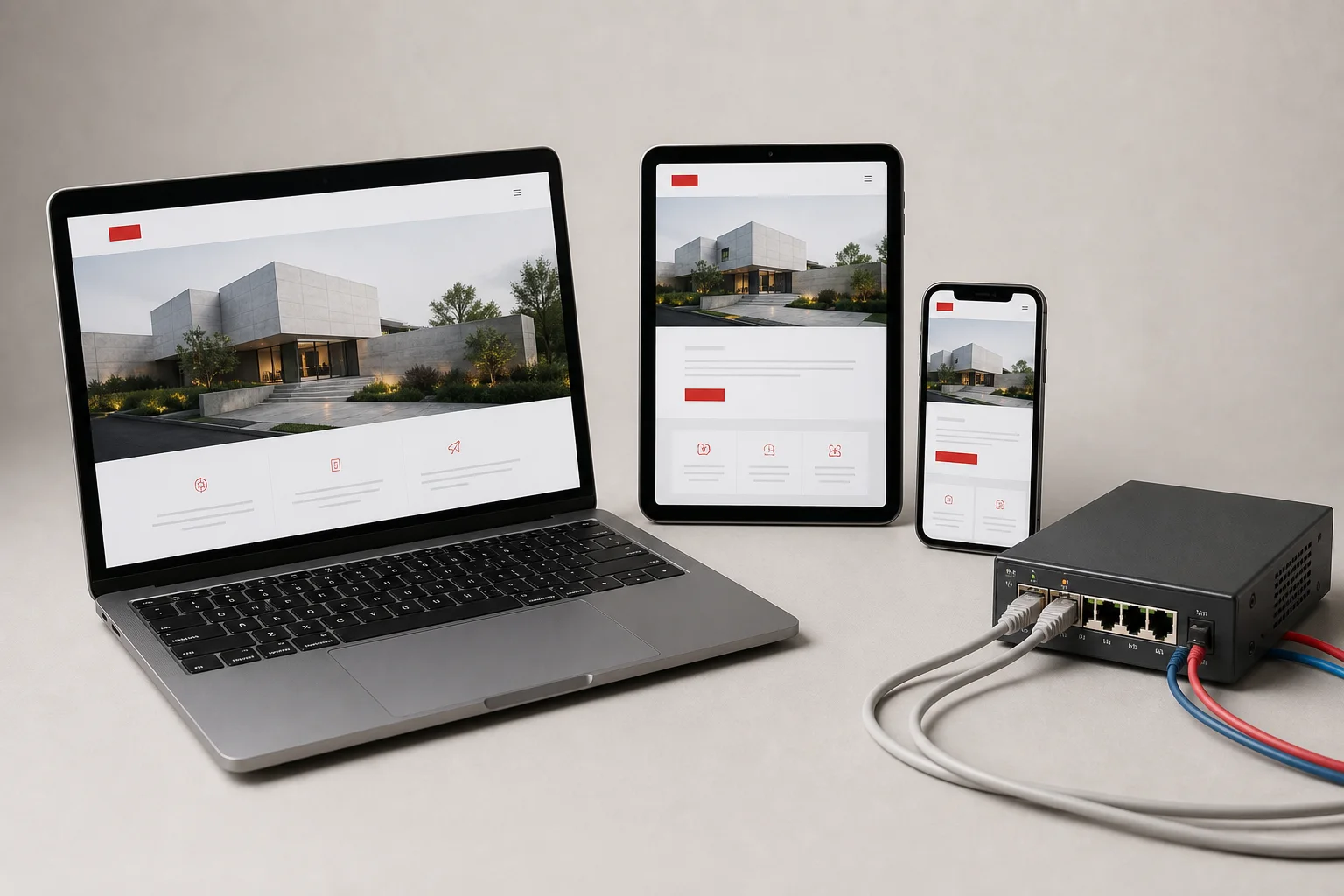
A freelancer can be efficient for a compact project centred on one discipline. A studio combines design, development, QA, and management. A complex product may need business analysis, UX, frontend, backend, QA, DevOps, SEO, and content expertise. A higher senior rate can reduce total cost when experience identifies risks early and simplifies architecture.
Fixed price or time and materials
Fixed price works when scope is documented and changes are limited. The supplier either prices uncertainty or strictly protects boundaries. Time and materials suits products that evolve and test hypotheses; the client pays for actual work and controls priorities. What matters is a transparent backlog, rates, reporting, and change process.
Costs after launch
Publication does not end the budget. A website needs domain and hosting, backups, monitoring, CMS and library updates, vulnerability fixes, integration support, and content work. Email services, maps, search, CRM, licences, analytics, file storage, and CDN may carry separate fees.
Calculate total ownership cost for at least two years. A cheap launch on an outdated theme may demand constant patches. Documented code, automated backups, and predictable support cost more initially but make change safer and reduce emergency rebuild risk.
How to compare supplier proposals
Do not compare final totals alone. Ask for the same decomposition: discovery, structure, design, frontend, backend, CMS, integrations, content, SEO, QA, launch, and warranty. Check the number of templates and iterations, ownership of responsive states and content entry, and the process for changes.
| What to check | Why it matters |
|---|---|
| Scope and exclusions | Reveal which work may be charged later |
| Team and roles | Show who owns design, engineering, and quality |
| Acceptance criteria | Replace subjective “done” with verifiable results |
| Code and design ownership | Protect the ability to change suppliers |
| Warranty and support | Define fixes and post-launch work |
How to reduce cost without damaging the result
- Define the primary business action. It helps defer features that do not affect launch.
- Separate MVP from later phases. Build the critical path first and develop from evidence.
- Prepare content before design. Real copy and images reduce redesign.
- Use a component system. Reusable blocks are cheaper to build, test, and maintain.
- Validate integrations before estimation. Documentation and sandbox access remove expensive uncertainty.
- Assign one decision owner. Consolidated feedback reduces idle time and contradictory changes.
Do not cut backups, security, basic SEO, or form testing. That does not remove cost; it delays it until the website is losing leads or traffic. Defer functionality that can safely arrive later instead.
How to obtain an accurate estimate
Prepare a concise brief covering the business, audiences, geography, primary goal, required pages, user roles, integrations, languages, available content, desired timing, and budget range. Add examples of specific functions or solutions rather than a list of sites that merely look attractive.
A standard project can then move to decomposition and estimation. An account-based service, complex integration, or migration benefits from paid discovery, API validation, and a prototype. Website cost in 2026 then becomes a transparent investment in defined scope, quality, and business outcomes rather than a random headline figure.