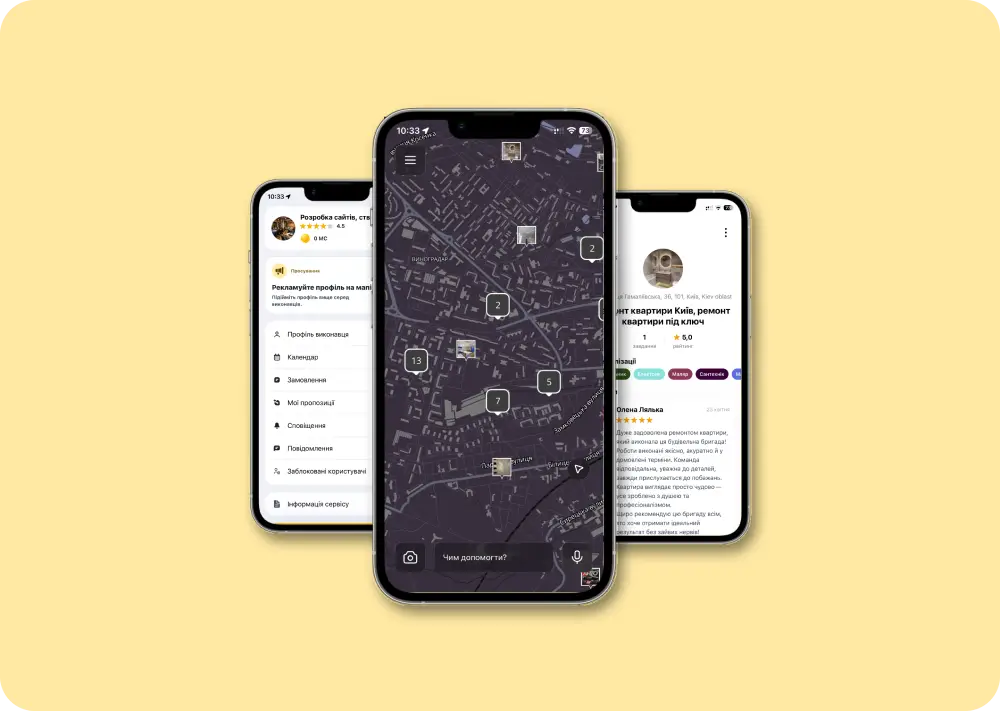
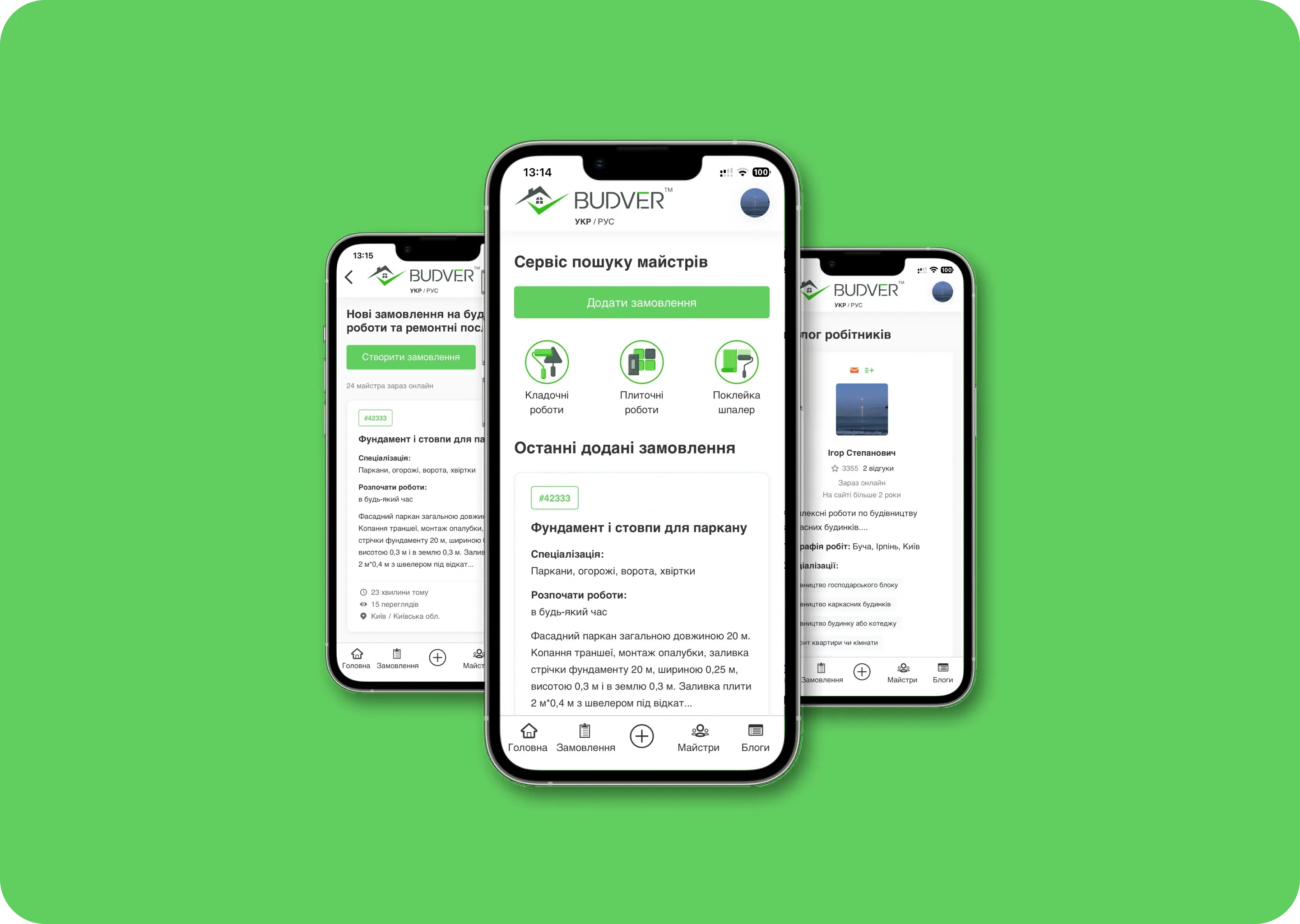
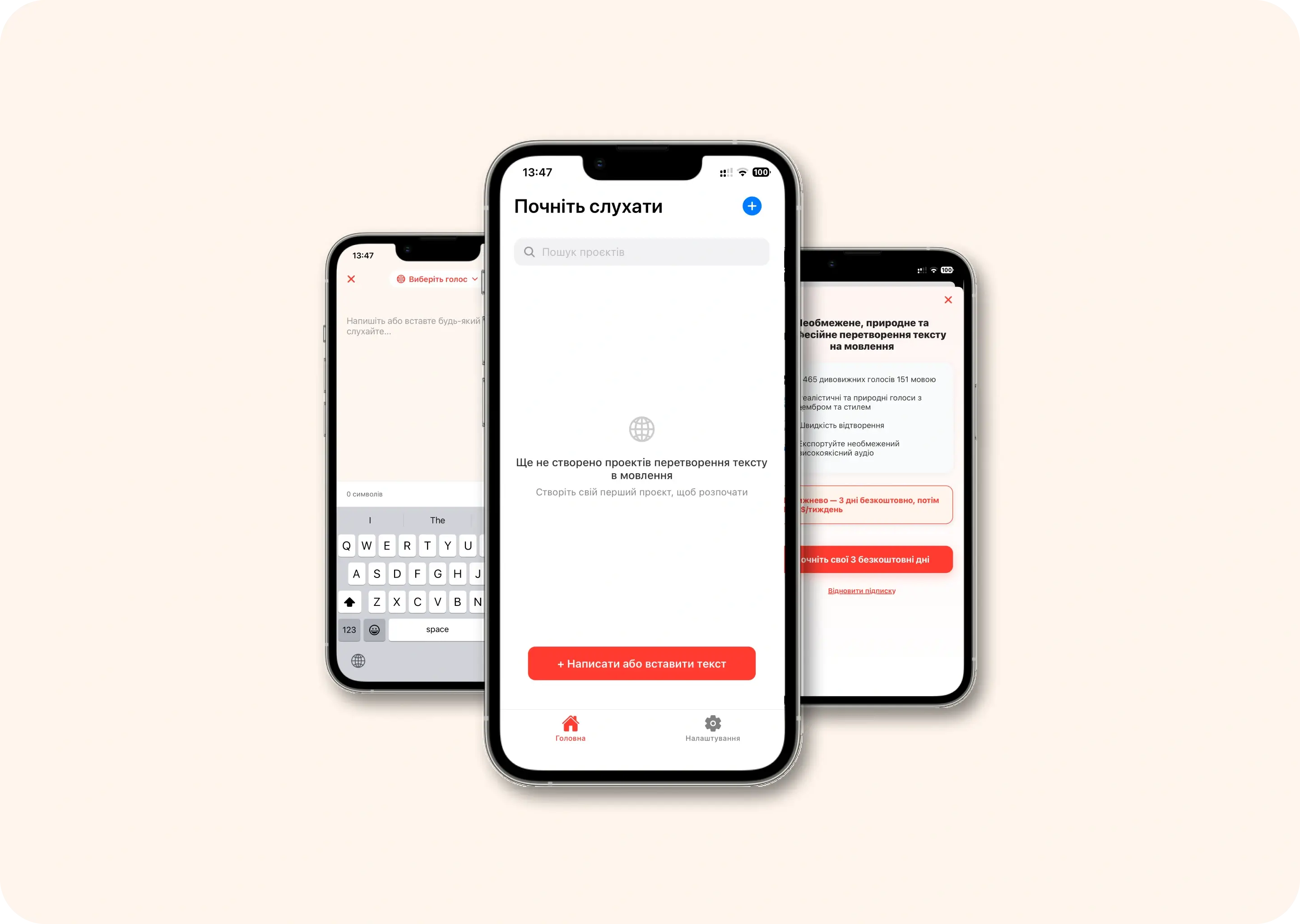
The iOS app development process is built step by step: from analyzing business goals and Apple ecosystem user behavior to design, development, and implementation of key functionality. After that, the app undergoes testing, performance optimization, and preparation for App Store publication, ensuring stable performance and a high-quality user experience on iPhone and iPad.
We analyze the business challenge, Apple device target audience, and usage scenarios of the iOS app. We define the key product value, core functionality, and user interaction model within the Apple ecosystem.
We design user scenarios considering iOS patterns: navigation, gestures, screen transitions, and key actions. This allows building a clear app structure before development begins.
We develop UI design in accordance with Apple Human Interface Guidelines, brand style, and usability. The interface is optimized for iPhone, iPad, and various screen sizes.
We build the iOS app, implement functionality, connect APIs, backend systems, and third-party services. We ensure stable performance, high speed, and data security.
We test the app on different iPhone models and iOS versions, verify logic, performance, and functionality. We optimize the app before release.
We prepare the iOS app for App Store publication, assist with Apple moderation, and configure accounts. If needed, we provide ongoing support and further product development.
If you are planning to create an iOS app that seamlessly integrates into the Apple ecosystem and becomes part of your business’s digital strategy, we are ready to bring your project to life. We develop iOS solutions focused on stability, performance, and a seamless user experience for iPhone and iPad users.
Leave a consultation request — we will analyze your idea, business goals, and App Store requirements, propose the optimal implementation format, and provide a clear estimate of timelines and budget. We work with companies in Kyiv and across Ukraine, creating turnkey iOS apps with the possibility of further development and scaling.
| Basic (MVP iOS) | Optimal (Business iOS) | Advanced (Premium iOS) |
|---|---|---|
| Price: from $4,000 | Price: from $7,000 | Price: from $10,000+ |
| Development — 25–35 days | Development — 45–65 days | Development — 75+ days |
| UX/UI for iOS based on Apple HIG | Custom UX/UI tailored for iOS | Premium UX/UI + UX analytics |
| Core iOS app functionality (MVP) | Full business functionality | Complex business logic and automation |
| 1 usage scenario | Multiple scenarios and roles | Flexible roles and permissions system |
| Simple iOS architecture | Optimized architecture | Scalable iOS architecture |
| Basic user scenarios | Extended interaction scenarios | Custom business and user scenarios |
| Local data / basic APIs | API, CRM, third-party services | Payments, subscriptions, complex APIs |
| iPhone support | iPhone + iPad | iPhone, iPad + optimization |
| Basic analytics | Events and user behavior | Advanced analytics and logging |
| Push notifications (basic) | Push + segmentation | Personalized push scenarios |
| App Store publishing | App Store + moderation support | Full release + post-launch support |
iOS app development is a complex multi-stage process that includes analytics, user experience design, development, testing, and App Store review. The price is not arbitrary — it depends on the depth of product design, number of scenarios, integrations, and scalability requirements.
That is why iOS apps are условно divided into several formats: from starter solutions for idea validation to full-scale business platforms that become part of a company’s digital strategy.
The initial iOS app format is designed for situations where it is important to launch the product as quickly as possible and test its viability. This approach is often used by startups, new services, or businesses entering the mobile channel for the first time.
In this case, the focus is not on the number of features but on a clearly defined user value. The app solves one specific problem, avoids unnecessary complexity, and allows you to gather real feedback from App Store users.
The cost of such a solution remains relatively affordable because:
the number of screens and scenarios is minimized;
native iOS logic is used without complex custom solutions;
the architecture is simple but designed for future growth;
only essential functionality is implemented.
This format allows businesses to avoid large financial risks while still getting a полноценний product in the App Store.
When a mobile app is viewed not as an experiment but as a sales, service, or customer interaction channel, the development approach changes. At this stage, deeper logic, personalization, and integrations with internal business systems become necessary.
Such an iOS app already:
serves multiple user types;
supports various behavioral scenarios;
integrates with backend systems, CRM, or third-party services;
collects analytics for business decision-making;
operates as part of a unified digital ecosystem.
The increased budget and timeline in this format are not due to “complexity for complexity’s sake,” but because the app begins to directly impact revenue, and mistakes at this level become more costly.
Business iOS is the choice for companies that want to launch a product with growth potential from the start, rather than rebuilding an MVP after a few months.
The advanced iOS app development format is designed for businesses where the mobile product is a key digital asset. This includes SaaS platforms, subscription services, financial solutions, and corporate systems.
At this level, the mobile app:
handles complex business processes;
automates internal operations;
works with payments, subscriptions, and financial scenarios;
features a flexible access system;
is ready for increased load;
requires ongoing analytics and optimization.
This is why developing such a product takes more time and requires serious planning from the start. The goal is not just to “launch an app,” but to build an architecture that will not break as the business grows.
Premium iOS apps are rarely built “once and for all.” They are long-term projects involving continuous development, updates, and support.
Clients often ask whether an iOS app can be built faster. In 2026, the answer is simple: faster is possible — but worse.
Timelines are directly related to:
depth of UX design;
number of scenarios;
testing scope;
App Store requirements;
post-release stability.
Unrealistically short timelines almost always lead to:
Apple moderation issues;
poor user reviews;
expensive post-launch fixes.
Therefore, realistic timelines are not a drawback but a guarantee of quality.
In 2026, a dedicated iOS app:
reduces customer acquisition costs;
increases repeat sales;
creates a direct communication channel;
strengthens the brand;
provides full control over user experience.
That is why the right development approach is not about finding the “cheapest option,” but choosing a format that matches your business goals today.
If you are planning to develop an iOS app and want to clearly understand the price, timeline, and outcome, we will help you choose the optimal format — from MVP to a scalable Premium solution.
A turnkey iOS app is not just code, but the foundation of a company’s digital strategy.
Turnkey iOS app development is available for businesses not only in Kyiv but throughout Ukraine — in Kharkiv, Lviv, Odesa, Dnipro, Zaporizhzhia, Vinnytsia, Poltava, Cherkasy, Chernihiv, Sumy, Zhytomyr, Rivne, Lutsk, Ternopil, Ivano-Frankivsk, Uzhhorod, Khmelnytskyi, Chernivtsi, Kropyvnytskyi, Mykolaiv, and Kherson. Regardless of region, modern collaboration formats allow the full cycle of iOS app creation — from idea analysis and UX/UI design to App Store publication and дальнейшее product growth.
The cost of iOS app development depends on the depth of UX/UI design, number of user scenarios, integrations, analytics, App Store requirements, and future scalability. MVP solutions start from $4,000, business-level apps from $7,000, and advanced premium iOS products from $10,000 and above. The exact budget is determined after analyzing the requirements and is fixed before development begins.
Timelines depend on the project scale. A basic MVP iOS app can be developed in 25–35 days, a business-level app in 45–65 days, and a premium solution with complex business logic, automation, and integrations requires 75 days or more. Actual timelines always depend on the number of scenarios, screens, testing, and the complexity of App Store approval.
Turnkey iOS app development includes analytics, UX/UI design according to Apple standards, architecture planning, feature development, integrations with APIs, CRM, or payment systems, testing on iPhone and iPad, release preparation, App Store submission and approval, and ongoing support. As a result, the business receives a complete product, not just a technical implementation of отдельных features.
MVP iOS is suitable for validating an idea, quick launch, and working with one key scenario. Business iOS is designed for companies that want a full business tool with multiple scenarios, user roles, integrations, and analytics. Premium iOS is intended for complex products with custom UX/UI, subscriptions, automation, scalable architecture, and deep business logic.
Timelines are directly related to UX design, number of scenarios, testing, App Store technical requirements, and product stability after release. Artificially shortening timelines increases the risk of Apple rejection, poor user experience, negative reviews, and costly fixes after launch. Realistic timelines are part of ensuring quality in iOS development.
This depends on the selected development format. In the basic package, support is usually for iPhone only; in Business iOS, both iPhone and iPad support can be included; and in Premium iOS, we provide separate optimization for different Apple devices to ensure proper performance across all key scenarios.
Yes, we can integrate the iOS app with APIs, CRM, third-party services, payment systems, subscriptions, analytics tools, and internal business systems. The scope of integrations depends on project requirements: in MVP these may be basic APIs, in Business iOS integrations with CRM and services, and in Premium iOS complex payment and business integrations.
Yes, push notifications can be included in all development formats. In the basic version, these are simple push messages; in Business iOS, segmented notifications; and in Premium solutions, personalized push scenarios, automation, and deeper engagement and retention strategies.
Yes, we support the App Store publishing process: preparing builds, setting up accounts, creating app store assets, and passing Apple review. In the basic package, this includes publishing; in Business iOS, moderation support; and in Premium iOS, full release management and post-launch support.
Yes, we design iOS apps with future growth in mind. The architecture can be built to allow adding new roles, scenarios, integrations, subscriptions, analytics, and automation without rebuilding the app. This is especially important for SaaS solutions, business services, and products planning long-term growth.