Website promotion in Google is not magic or “secret algorithms,” but systematic work on the technical condition of the website, content, structure, and authority of the resource. Even without a large budget, it is possible to significantly improve search rankings if you approach SEO optimization correctly.
In this article, we will look at where to start promoting a website on your own, how to conduct a basic SEO audit, find keywords, optimize content, and gradually increase organic traffic.
Where to start website promotion?
Website promotion in search engines should begin not with buying ads or mass writing content, but with understanding the current state of your project. Many website owners make the same mistake — they try to immediately “promote” pages even though the website itself is technically not ready for proper indexing and ranking in Google. If a website has technical issues, duplicate pages, an incorrect structure, or slow loading speed, even good content may not bring the expected results.
The first stage of SEO promotion is building a solid foundation. Search engines evaluate a website comprehensively: how user-friendly it is, how quickly it loads, whether visitors can easily find the information they need, whether the pages are properly optimized, and how authoritative the resource appears within its niche.
That is why you should start with a basic website analysis and setting the right goals.
Define the purpose of promotion
Before starting any SEO work, you need to understand why exactly you are promoting the website. Different types of businesses may require completely different strategies.
For example:
- an online store needs product sales;
- a service website needs inquiries and phone calls;
- an informational blog needs organic traffic;
- a local business needs customers from a specific city;
- a SaaS or online service needs user registrations.
Without a clear goal, it becomes very difficult to evaluate SEO effectiveness in the future.
Conduct a basic SEO audit of the website
An SEO audit is the first and one of the most important stages of website promotion. Without it, it is difficult to understand why pages are not ranking in the TOP results of Google, why the website receives little traffic, or why users quickly leave the website.
Essentially, an SEO audit is a comprehensive website check that helps identify technical, structural, and content-related issues preventing proper ranking. Very often, even small mistakes can significantly affect the visibility of a website in search results.
Checking the technical condition of the website
The first step of independent SEO promotion is a technical website audit. Before optimizing content or working on external promotion, you need to make sure the website works correctly for both users and search engines. Even high-quality content will not help you rank in Google if the website contains critical technical errors.
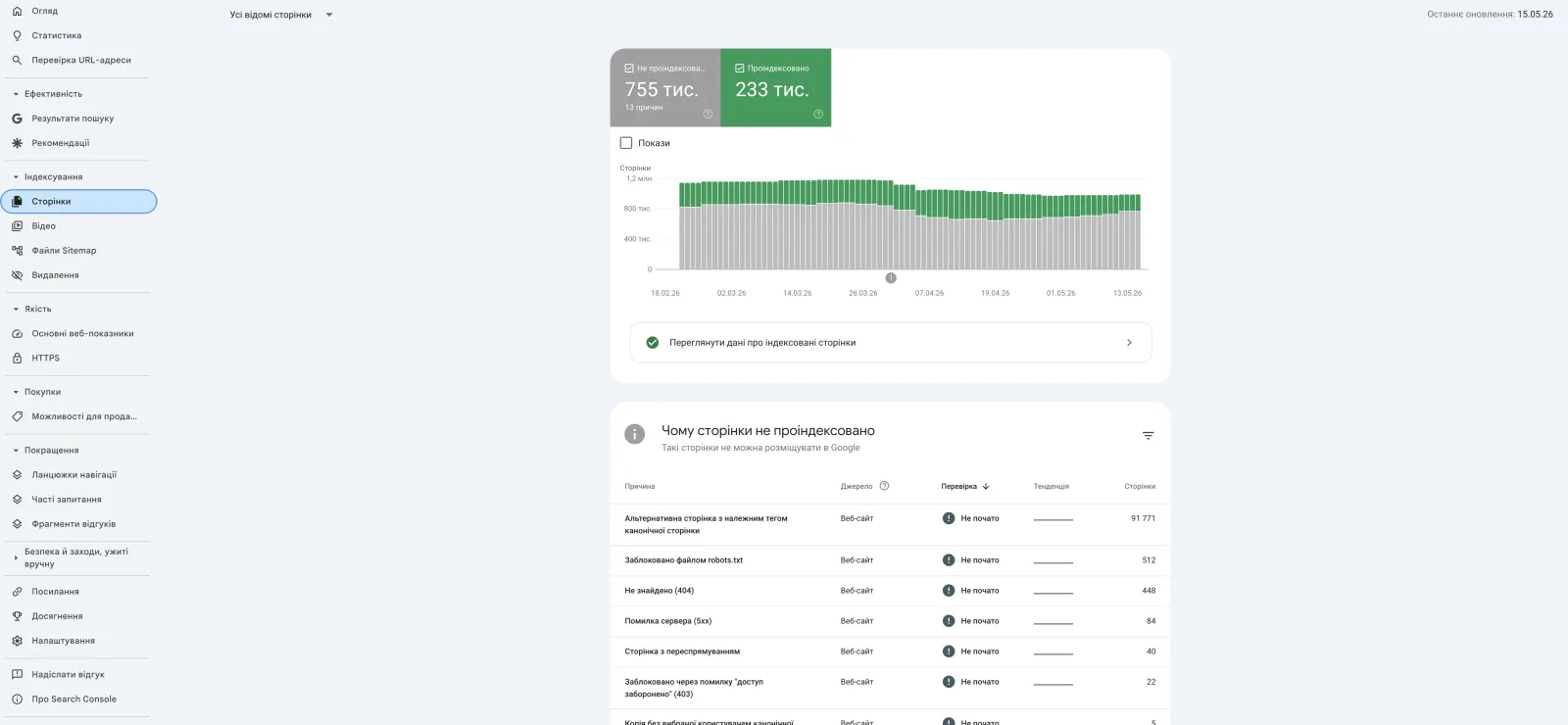
For basic analysis, it is most convenient to use the free Google Search Console service. It allows you to identify indexing problems, pages with errors, duplicate URLs, and pages Google cannot properly crawl.
Special attention should be paid to:
- pages with 404 errors;
- duplicate URLs;
- indexing issues;
- incorrect redirects;
- pages blocked from search engine bots.
If technical problems are found during the audit, they should be fixed either through the website CMS or directly on the server. For example, outdated pages should either be removed or redirected using a 301 redirect to relevant URLs. Broken links should be replaced or removed entirely so users do not land on error pages.
How to check errors in Google Search Console
To view website issues:
- Open Google Search Console.
- Select the required website.
- In the left menu, go to:
“Indexing” → “Pages”. - Review the report with errors and excluded pages.
In this section, Google shows:
- 404 pages;
- duplicate pages;
- canonical issues;
- non-indexed pages;
- crawl errors;
- redirect problems.
Regularly checking this section helps quickly identify issues that may negatively affect SEO.
Fixing broken links and duplicate pages
During SEO promotion, it is very important not only to create new content or optimize pages for keywords, but also to regularly check the website for technical errors. Broken links and duplicate pages remain among the most common problems. They can significantly worsen website indexing, reduce search engine trust, and negatively affect Google rankings.
For search engine bots, a website should be logical, understandable, and technically stable. If Google detects a large number of errors, duplicate URLs, or non-working pages, it may reduce crawling efficiency and worsen the ranking of even high-quality pages.
That is why regular monitoring of such issues is an important part of any SEO audit.
What are broken links?
Broken links are URLs leading to pages that have been deleted, moved, or no longer exist. In most cases, users see the following error:
404 Not Found
Sometimes the page may return server errors or other status codes:
- 410 Gone;
- 500 Internal Server Error;
- 403 Forbidden.
Such problems often appear after:
- changing the URL structure;
- deleting products or articles;
- website migration;
- redesign;
- incorrect CMS configuration;
- manual link editing.
On large websites, broken links can accumulate for years, especially if technical audits are not conducted regularly.
Why do broken links negatively affect SEO?
A large number of non-working URLs creates a negative signal for both users and search engines. If a user lands on an error page, they will most likely leave the website immediately. This worsens behavioral metrics and reduces trust in the resource.
For Google, broken pages are also a problem because the search bot wastes resources crawling non-existing URLs instead of important pages.
Main problems caused by broken links:
- poor user experience;
- higher bounce rate;
- loss of internal SEO value;
- weakened internal linking;
- more difficult indexing;
- wasted crawl budget.
Errors are especially critical in:
- website menus;
- categories;
- sitemap.xml;
- breadcrumbs;
- buttons and forms;
- internal SEO blocks.
If a website contains many pages with errors, it can significantly reduce the overall quality of the resource in Google’s eyes.
How to find broken links on a website?
To check a website, you can use special SEO tools that automatically scan pages and identify problematic URLs.
One of the most convenient free tools is: Dead Link Checker
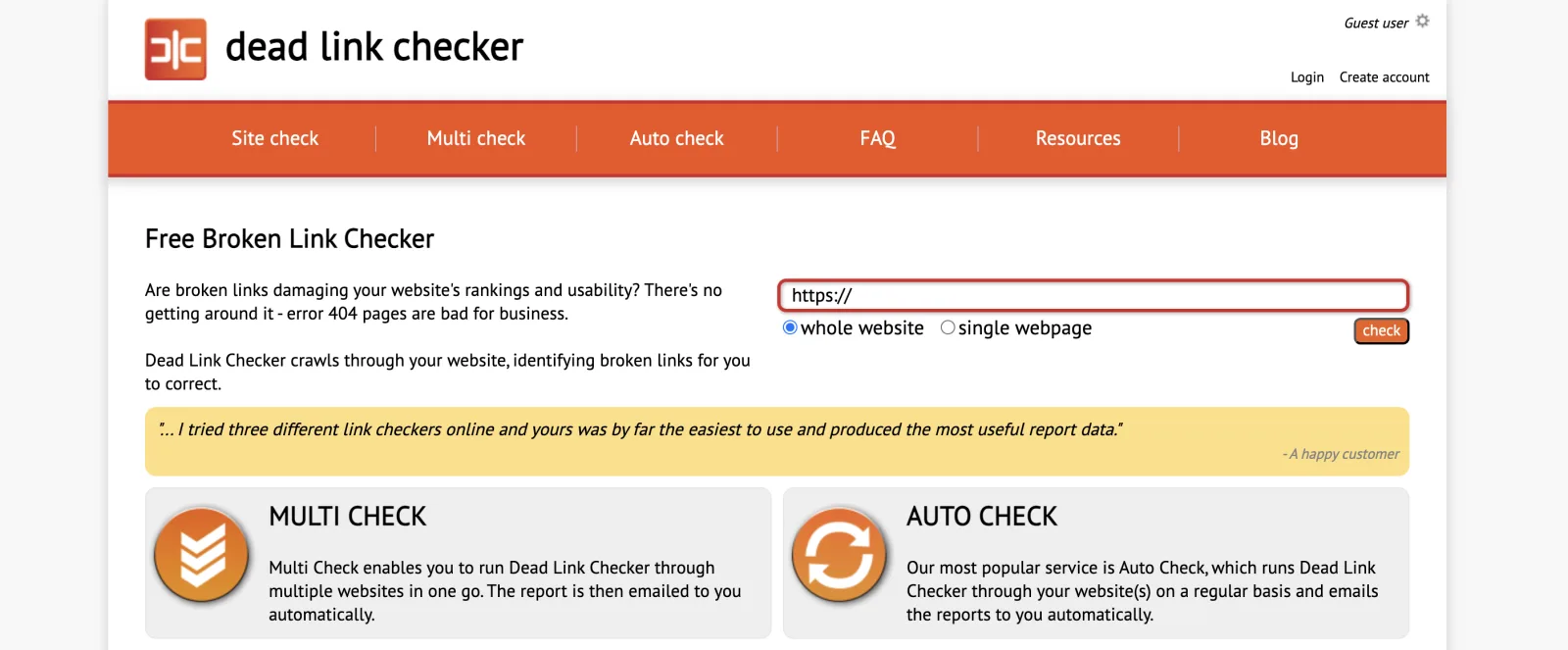
The service allows you to:
- check internal links;
- find 404 pages;
- detect redirect errors;
- check external URLs;
- quickly identify problematic pages.
For small websites, this is often enough to find most technical issues.
You can also use:
- Google Search Console;
- Ahrefs Webmaster Tools;
- Netpeak Spider;
- Sitechecker;
- Xenu Link Sleuth.
It is especially useful to regularly review reports in Google Search Console because Google shows exactly the pages it cannot properly crawl.
How to properly fix broken links?
After identifying problematic URLs, it is important not to simply delete pages, but to process them correctly from an SEO perspective.
Possible solutions include:
- replacing the link with an relevant URL;
- setting up a 301 redirect;
- updating URLs in menus;
- restoring important pages;
- removing unnecessary links;
- fixing CMS errors.
If a page previously received traffic or had external backlinks, it is best to set up a permanent 301 redirect to a relevant page. This helps preserve SEO value and prevents losing users.
It is also important to update:
- sitemap.xml;
- internal linking;
- breadcrumbs;
- menus;
- HTML sitemap.
Responsive design and page loading speed
One of the key factors of modern SEO is website speed and proper display on mobile devices. Google has long considered these indicators when ranking pages, so a slow or inconvenient website is much harder to promote to the TOP of search results.
If insufficient attention is paid to optimization during website development, pages may load too slowly, causing users to leave before they even get familiar with the content. This increases the bounce rate, worsens behavioral metrics, and lowers overall trust in the website. This is especially critical for new projects, since search engines closely analyze how audiences interact with new resources.
Website speed affects not only SEO, but also conversion rates directly:
- number of inquiries;
- sales;
- page views;
- time spent on the website;
- returning visitors.
Even a delay of a few seconds can noticeably reduce the number of potential customers.
How to check website speed?
For a basic speed analysis, it is most convenient to use the free service Google PageSpeed Insights
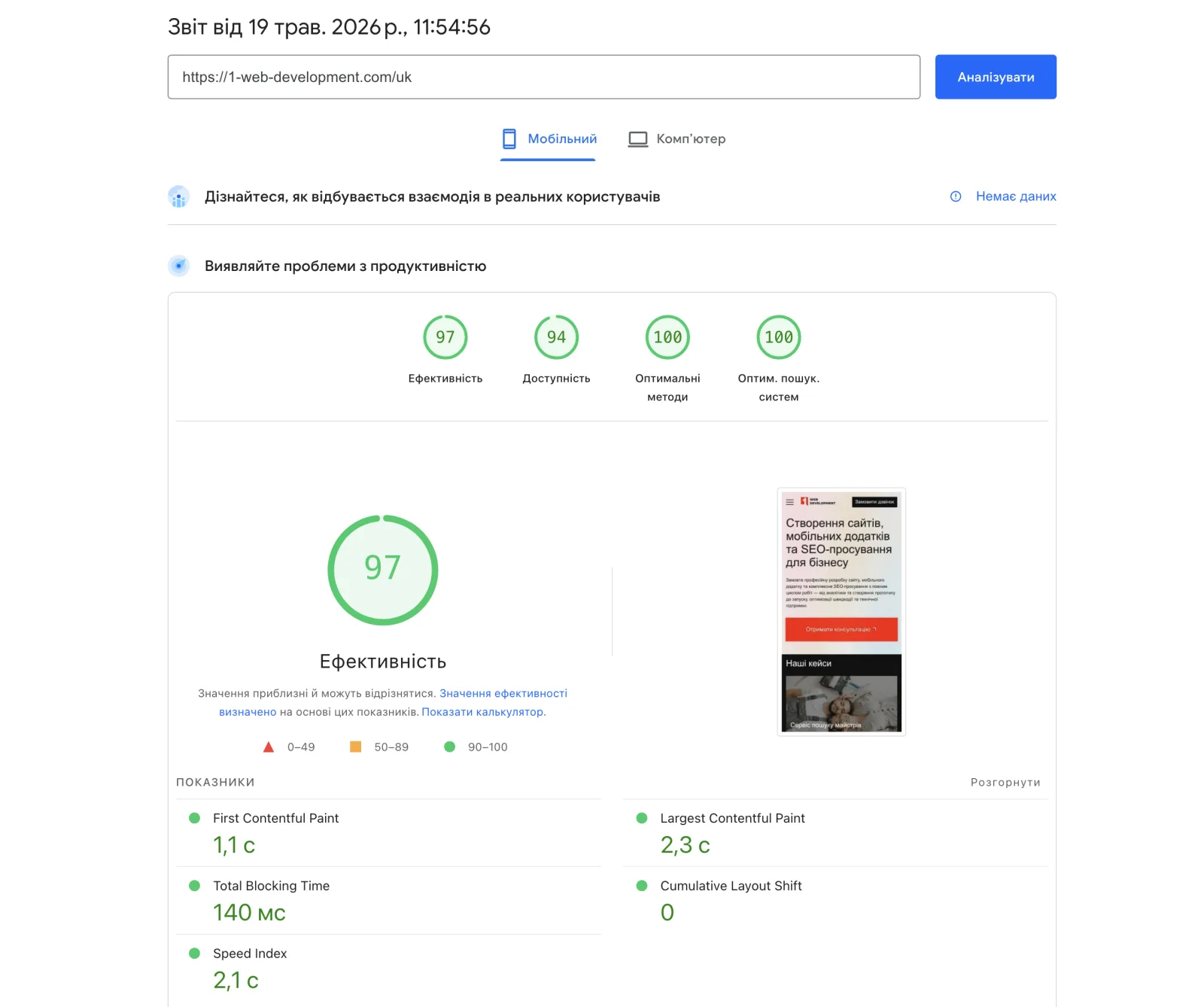
This tool analyzes:
- loading speed;
- website performance;
- image optimization;
- layout stability;
- mobile responsiveness;
- Core Web Vitals.
After analysis, the service provides separate scores for:
- mobile devices;
- desktop version.
Google also automatically provides optimization recommendations and explains which elements slow down the website.
Availability and proper configuration of sitemap.xml and robots.txt
When independently promoting a website, it is very important to check the correct functionality of sitemap.xml and robots.txt files. Many website owners underestimate their importance, although these files help search engines properly crawl pages, find new content faster, and understand the website structure.
If sitemap.xml or robots.txt are configured incorrectly, Google may index the website more slowly, skip important pages, or fail to see some content at all. This is especially critical for new websites, online stores, blogs, and large catalogs with hundreds or thousands of pages.
At this stage, we have only reviewed the basic but extremely important steps of SEO optimization. Technical audits, speed analysis, duplicate page detection, and proper sitemap.xml and robots.txt configuration are the foundation of any Google promotion strategy. Without a strong technical base, even high-quality content and backlinks will not provide stable results.
It is important to understand that SEO is a comprehensive and long-term process. Technical analysis alone is not enough to quickly reach the TOP of Google search results. Search engines evaluate websites based on hundreds of factors, including:
- content quality;
- website structure;
- internal linking;
- behavioral metrics;
- external backlinks;
- website expertise;
- mobile responsiveness;
- loading speed;
- structured data implementation;
- optimization for user search intent.
That is why SEO promotion is not limited to fixing technical errors. After the basic audit, you need to move on to deeper website optimization.
In the following sections, we will take a detailed look at:
- how to properly build a semantic core;
- how to analyze competitors;
- how to optimize SEO content;
- how to set up internal linking;
- how to improve website structure;
- how Link Building works;
- how to use schema.org;
- how to improve CTR in Google;
- how to promote a website without a large budget.
Step-by-step implementation of even basic SEO recommendations can already bring noticeable results for a young or small website. The main thing is to work systematically, regularly check the technical condition of the resource, and gradually improve every element of optimization.